We discussed in an earlier thread having an area where we can post details of how we brew our beers and what equipment and methods we use. My hope is that such posts will help share ideas and allow improvements to be made.
The way I'm going to try and do it is have this first post repeatedly edited to reflect changes I make to my "brewery". When I make an edit I think worth sharing I'll pop a new post up relating to the change. The downside is that this first post risks becoming a book but we'll see.
The Brewer
I'm nearer seventy than sixty and totally and utterly retired. The latter half of my working life was spent in product development for a local food factory here in West Lothian. At the start of my career I nearly entered the brewing industry but I'm glad I didn't. I like getting my hands mucky and modern breweries are too like the chemical industry with everything taking place out of reach inside pipes and tanks. Now I've more time, brewing is a good hobby and at it's starting point requires little equipment to produce beverages that are as good if not better than shop bought. Brewing for me started as a student in the sixties with a plastic dustbin and various Boots kits. After a long hiatus I started doing Woodforde Wherry kits and was amazed at how good the results were. Now I have found it is easy to buy the raw materials in and start from scratch with all grain brews.
The Brewery
Sited in Scotland, in my garage, the brewery ambient temperature normally lies between 5°C and 20°C which is perfect for brewing. In warmer climes a brew fridge is required to avoid fermenting at too high a temperature. I have one but rarely use it for anything other than keeping the finished beer cool.
The garage is built into the house with easy internal access. It has electricity, water and drainage and the working area was created from the old units when we renewed our kitchen. The stainless steel sink and drainer with water supplied from a hose and a simple pipe to drain are great to have and make cleaning up afterwards efficient. Other luxuries are an old carpet underfoot and a pulley in the ceiling above. An up and over door makes for easy ventilation.
The Equipment
I initially started out with a plastic fermenting bucket, a syphon and some bottles which was enough to brew Wherry kits. I then acquired a Burco electric tea urn which enabled all grain brewing with BIAB (brew in a bag).
I have a Chinese copy of a Corona mill which I use for grinding grain. It is crude but gets the job done and when powered with a battery drill is efficient.
The Burco was modified to allow it to continuously boil. It was insulated with a camping mat gaffer taped in place to make it more efficient. I added a ball valve tap in place of the original one and some stainless steel fittings to allow a bazooka to filter out solid material before it clogs the tap.
The Burco has an exposed element which is covered using an inverted colander to avoid damaging the grain bag. The colander
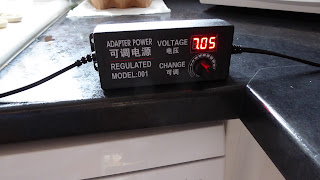
Two final items, to control the Burco are an Inkbird to enable accurate temperature control and a voltage regulator to control the amount of energy fed in so that a less vigorous boil can be achieved.
Silicone tubing and a heat resistant food safe pump allows wort recirculation and transfers to be made without lifting heavy containers.
Additional equipment includes a hydrometer, thermometers, a "little bottler", bottles, cardboard crates and a bottling tree and washer unit.
Burco Boiler Mods
My Burco tea urn was gifted by nephew Jamie when he emigrated to Houston.
It is a 30l model with an exposed element and is slightly modified so that it can maintain a rolling boil. An Inkbird and a voltage regulator are used to control temperature and kW input. I've been using this to brew beer using BIAB.
Recently I have wanted to remove the need for lifting 23 litre batches and I have purchased a pump. This may also allow the tea to function as a Kettle RIMS and I have purchased items to allow this to be tested. The initial test looks promising but when I get to do a brew I'm sure there will be more work required.
The inside of the urn now has a bazooka with stainless steel fittings leading to the back of a ball valve tap. I will have an inverted colander covering the element to protect the bag.

The grain bag is attached with bulldog clips. It has always been difficult to achieve and control my mash temperature because of the amount of space below the bag.

I've bought a generic little brown pump, a voltage regulator and some silicone tubing to allow transfers and recirculation. The first test with water at 80ºC seems promising.


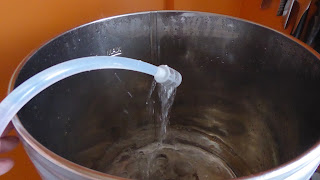
The pump could be attached directly to the tap but I want to use it elsewhere plus it's plastic and not overly robust so I'll have a couple of lengths of silicone tubing attached to it.
The next thing is it to test it for real with a brew. My main concern is that the pump flow may be a little fast but I understand that I can constrict the flow if the voltage regulator does do the job. I also have the option to rest a holey plastic bucket on top of the colander with the bag in that and any overflow over the top would just return to the Burco.
The Raw Materials
In Germany the purity of beer was controlled by the Reinheitsgebot which allowed only water, barley, hops and yeast to be used in its production. I don't subscribe to this but nevertheless these remain the main ingredients I use.
Water, from the tap is very soft and contains chloramine. I add a campden tablet to remove the chloramine and occasionally adjust the water chemistry to better suit a particular type of beer.
Barley is available in many forms from homebrew suppliers. Pale Ale malted barley forms the backbone to my recipes and I buy this as wholegrain in 25kg sacks direct from local maltsters.
Hops are also available in a plethora of varieties from homebrew suppliers. I also have hops growing up the side of the house but that's another story.
Yeasts I am learning are crucial to giving the characteristic organoleptic properties to great beers. They are available dried or in liquid form. I particularly like Nottingham as a work horse yeast for most beer types and WLP644 for hoppy beers.
The Recipes
I'm going to link recipes that I have had success with to an xml file stored in the cloud. This will allow them to be viewed on most brewing software although I personally use BrewMate available here. https://www.softpedia.com/get/Others/Miscellaneous/BrewMate.shtml
The Method at the moment


